At this moment i'm writing my report and am I finishing up for the exhibition next Thursday and Friday.
Inthis report my second version of the wind sensor will be described as well as all the other parts of the project. of course this all will be published here on the blog, for now my poster for the exhibition
Protei project and assignment Process blog
dinsdag 5 juni 2012
zaterdag 26 mei 2012
Exploratory sketching
In this sketch you can see the vanishing point of the tape roll holder is in front of the object which is very strange looking.
These 2 sketches are made before class as well as the 4 sketches below, the printer looks good on the bottom side but at the top side something strange happens which is caused by the left upper corner which goes to much to the right which causes the printer top is not in the center of the printer but slightly of set to the right. This could be solved by making the curve the same (but reversed) as the curve on the right side.
Also the alarm clock has the problem with the vanishing point on the wrong side of the sketch.
These 2 sketches are made before class as well as the 4 sketches below, the printer looks good on the bottom side but at the top side something strange happens which is caused by the left upper corner which goes to much to the right which causes the printer top is not in the center of the printer but slightly of set to the right. This could be solved by making the curve the same (but reversed) as the curve on the right side.
This sketch was to communicate a scene. I used numbers to indicate in which order the sketch needs to be read. in this case first the watch gathers data from the user and decides if the user needs to be activated (in this example the user is sitting on a chair which vibrates) and the overall progress of the users is visualized on a very wide screen on the wall on which they all conquer a common goal.
I already sketched 2 1/2 hours in the park Wednesday, I studied different perspectives of the photo camera and some other objects given during the assignment. I will post these sketches as soon as I finish the other other hours(probably Tuesday).
A step closer to autonomous sailing
At this moment i'm a step closer to the semi autonomous sailing vessel.
I completed the code to adjust the rudder gradually depending on how big the turn needs to be.
This means that when the boat has to correct his course 1 or 2 degrees the rudder will only make a very small movement and when for example the course is changed from 90 degrees to 120 degrees there will be a bigger rudder deflection.
the incoming data is based on a compass from sparkfun (LSM303) which is a tilt compensated compass which is very valuable for a sailing vessel, it doesn't check the information with the GPS module at this moment and I doubt if I will manage to implement the GPS module.
The next step for me is to implement the wind sensor in the code and adjust the main sail according to the data from the wind sensor. In this way the main sail will always adjust its settings accordingly to the wind and thus have always the optimum position.
I completed the code to adjust the rudder gradually depending on how big the turn needs to be.
This means that when the boat has to correct his course 1 or 2 degrees the rudder will only make a very small movement and when for example the course is changed from 90 degrees to 120 degrees there will be a bigger rudder deflection.
the incoming data is based on a compass from sparkfun (LSM303) which is a tilt compensated compass which is very valuable for a sailing vessel, it doesn't check the information with the GPS module at this moment and I doubt if I will manage to implement the GPS module.
The next step for me is to implement the wind sensor in the code and adjust the main sail according to the data from the wind sensor. In this way the main sail will always adjust its settings accordingly to the wind and thus have always the optimum position.
The compass module connected to the arduino.
on this picture connected to the computer to read the serial
communication and in this way check the program.
maandag 21 mei 2012
Deaf Presentation
Last thursday we were at DEAF festival, where we presented our project and met Cesar Harada and some other members of Protei and other interested people. here you see some photo's of the meetings which took place. later I will also post the photo's of other interesting parts on the deaf festival.
As a very cool present, I got an actual oil boom to test with.
Also, we are nearing the end of our semester and are therefore presenting our work at our final exhibition at TU/e. We will be presenting our work on Thursday June 7th, form 9.30 to 11.30 and on Friday june 8th from 13.30 to 15.30 in the Next Nature Theme (that is in the purple space on the 4th floor of the main building of TU Eindhoven) you are very welcome to come visit us and see our work.
As a very cool present, I got an actual oil boom to test with.
Also, we are nearing the end of our semester and are therefore presenting our work at our final exhibition at TU/e. We will be presenting our work on Thursday June 7th, form 9.30 to 11.30 and on Friday june 8th from 13.30 to 15.30 in the Next Nature Theme (that is in the purple space on the 4th floor of the main building of TU Eindhoven) you are very welcome to come visit us and see our work.
update
at this moment i'm working on the report and on the assignments but I do not have enough time to also write on the blog.
donderdag 10 mei 2012
scenario
My first design concept was about; how users could design and build there boat themselves and then put those boats into the sea and control them from there own homes. After working on this project I found out that many of those boats which are build aren't good qualitative build boats. By keeping in mind that the garbage spills in the ocean keep growing (source: http://www.wlsam.com/Article.asp?id=2452508&spid=) it can be considered not so smart to let everybody build there boat and put them at sea without a quality check.
At this moment however we aren't ready to build autonomous boats and let them sail the oceans to clean up oil. this research process is in a too early stage for this. I build this boat not to facilitate the mechanical/physical innovation for protei, such as the shape-shifting hull, but more to explore the innovation of the intelligence and control of the boat. When more of these boats are build also inter-boat cooperation can be researched.
So what I facilitate is a platform for competition between different protei developers which are developing new versions of this boat at home and improve the design and test it themselves. The outcomes of all these individual developments are shared in the community and in this ongoing competition all users will build upon the previous design.
In my final report I will include an extensive how to build chapter to reproduce this boat and build upon the things I've designed
thoughts about protei
At this moment Protei is in his research phase, a change in culture caused that this research isn't done in the conventional way but distributed over a large open source community. I'm one of the many people working on protei and even I work in a small community with my fellow wild robots project members.
My research project focuses on the sailing drone, which is part of the bigger system, with a mother ship which can collect the oil-absorbent tails when they are saturated, flying drones to spot where the oil is etc.
In this bottom up research process I build one sailing drone which is the basis for researching autonomous behavior the boat can fully adjust his actuators and can sense where it is, in which direction it is heading and where the wind is coming from, also the speed of the boat and how much leeway the boat has (+ other data derived from gps). The complex system I created in this way with a bottom-up approach can now be extended. The Boat I build cannot be send to sea and clean up oil already, but can show the capabilities. Also it shows that home build boats (see also the project of Martijn and Stijn) which are made by children aren't seaworthy. But can increase the knowledge about sailing drones. Therefore this distributed research method is very powerful in creating knowledge and building upon the existing knowledge already created by the community, which in the end enables protei to build and manufacture hundreds of highly efficient complete autonomous sailing drones which can clean up oil spills and at the same time collect data at sea.
Because this is a research project, I will also work on the collective paper of protei to publish my findings during this project and pass on my knowledge to the next group working on this.
My research project focuses on the sailing drone, which is part of the bigger system, with a mother ship which can collect the oil-absorbent tails when they are saturated, flying drones to spot where the oil is etc.
In this bottom up research process I build one sailing drone which is the basis for researching autonomous behavior the boat can fully adjust his actuators and can sense where it is, in which direction it is heading and where the wind is coming from, also the speed of the boat and how much leeway the boat has (+ other data derived from gps). The complex system I created in this way with a bottom-up approach can now be extended. The Boat I build cannot be send to sea and clean up oil already, but can show the capabilities. Also it shows that home build boats (see also the project of Martijn and Stijn) which are made by children aren't seaworthy. But can increase the knowledge about sailing drones. Therefore this distributed research method is very powerful in creating knowledge and building upon the existing knowledge already created by the community, which in the end enables protei to build and manufacture hundreds of highly efficient complete autonomous sailing drones which can clean up oil spills and at the same time collect data at sea.
Because this is a research project, I will also work on the collective paper of protei to publish my findings during this project and pass on my knowledge to the next group working on this.
maandag 7 mei 2012
electro permanent magnets -update
Today, I researched the possibilities to lock a servo with electro- permanent magnets. This solution still seems possible, but isn't recently used for this application. Therefore I cannot guarantee at this moment that this technique will work. However I contacted a manufacturer of electro and permanent magnets about the possibilities and he will contact me soon. At the electrical engineering department I spoke with around 10 different professors in different fields of expertise and all of them didn't really know how to apply this on a servo motor. This was a little disappointing for me, and the best thing was to use a stepper-motor with permanent magnets inside. After looking into this I figured out that short cutting the wires of a stepper motor increases the friction inside the stepper motor, but still this force isn't strong enough to maintain course at sea.
Hopefully the manufacturer of these products can explain more about this technique so I can design the new servo with with zero static power consumption.
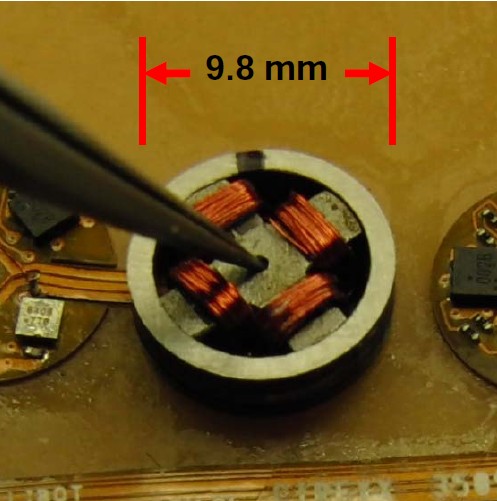
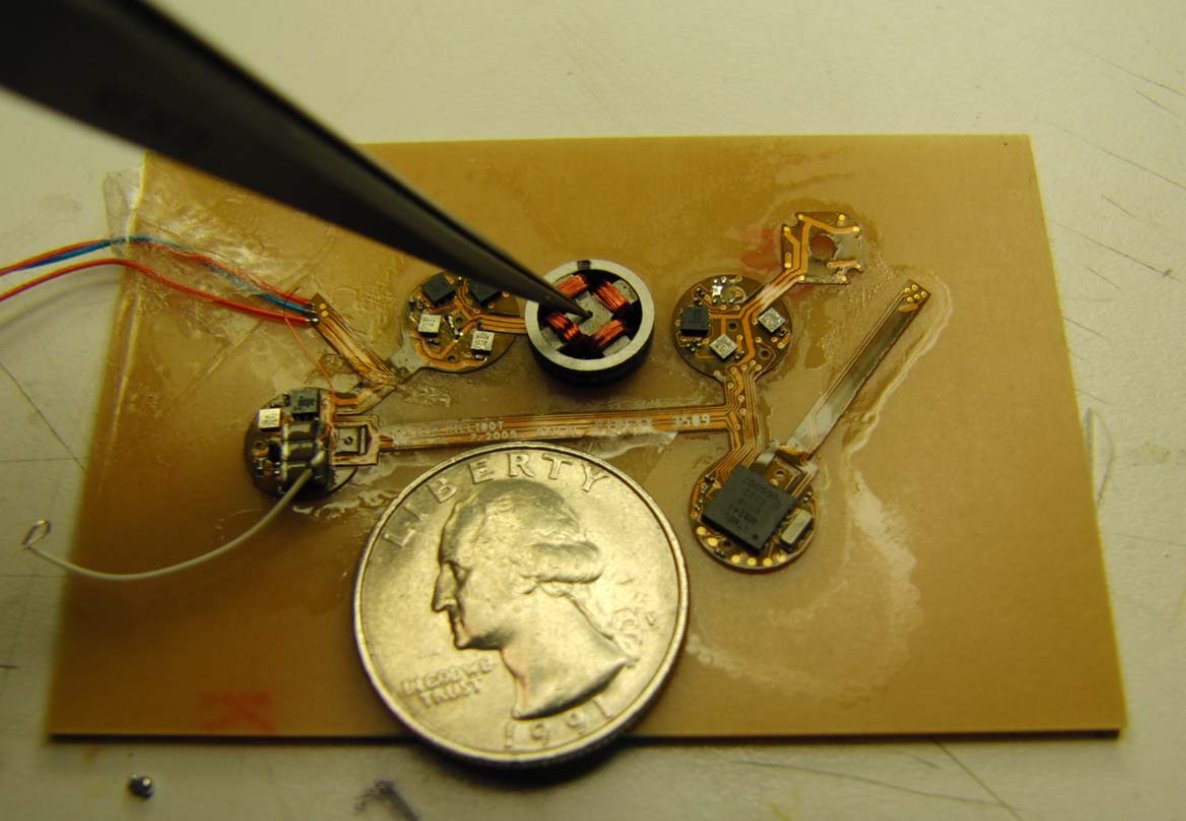
I also found another application of electro permanent magnets which are the cubelets (http://www.hizook.com/blog/2010/12/07/electropermanent-magnets-programmable-magnets-zero-static-power-consumption-enable-s)
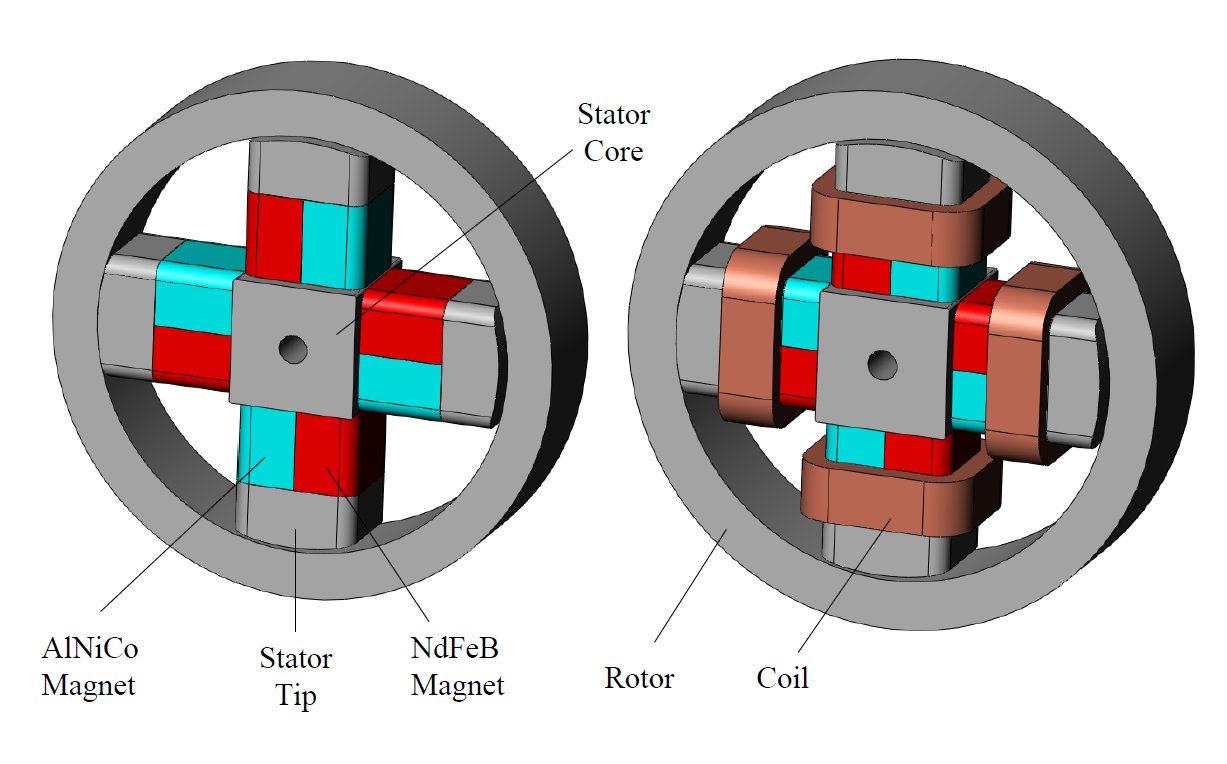
This website explains how you can build a steppe rmotor with the use of electro permanent magnets so this application has the lock function within the motor itself instead of my version with an external lock mechanism.
Essentially this combined my research into stepper motors and the electro permanent magnets. Unfortunatly for me it is already patent pending....
Quote:
unquote
source:http://www.hizook.com/blog/2010/12/07/electropermanent-magnets-programmable-magnets-zero-static-power-consumption-enable-
http://www.hizook.com/files/users/3/Electropermanent_Magnets_Knaian.pdf
Hopefully the manufacturer of these products can explain more about this technique so I can design the new servo with with zero static power consumption.
I also found another application of electro permanent magnets which are the cubelets (http://www.hizook.com/blog/2010/12/07/electropermanent-magnets-programmable-magnets-zero-static-power-consumption-enable-s)
This website explains how you can build a steppe rmotor with the use of electro permanent magnets so this application has the lock function within the motor itself instead of my version with an external lock mechanism.
Essentially this combined my research into stepper motors and the electro permanent magnets. Unfortunatly for me it is already patent pending....
Quote:
Electropermanent Magnet Stepper Motors:
One very interesting outcome of Ara's thesis was the development of (patent pending) EP magnet stepper motors. This tiny "wobble" stepper motor uses EP magnets in place of traditional stator windings (electromagnets).
By switching the state of nearby EP magnets, the motor will step through various (rotational) configurations.Owing to the unique properties of EP magnets, this type of stepper motor offers some interesting benefits.
- At low RPM (very little on-off switching), EP magnet motors have higher efficiency compared to electromagnetic motors.
- At zero RPM ("stall"), EP magnet motors still outputs constant force / torque. In electromagnetic motors, stall conditions result in massive power consumption -- this is a major problem for motor startup.
unquote
source:http://www.hizook.com/blog/2010/12/07/electropermanent-magnets-programmable-magnets-zero-static-power-consumption-enable-
http://www.hizook.com/files/users/3/Electropermanent_Magnets_Knaian.pdf
Windsensor and compass
The recently developed wind direction sensor is of course a nice feature for a sailing vessel but it isn't complete without a compass. This week I will combine a digital tilt compensated compass with the wind direction sensor. in this way it is possible to adjust the sails according to the wind and keep a certain heading according to the digital compass. In this way we will have an semi-autonomous sailing vessel which will automatically keep his heading and will adjust his sails according to the wind.
hope to update you at the end of this week about the progress regarding this matter.
electro permanent - servo
During this semester I used Servo motors as actuators to for the sailing drone. These servo motors require constant power when a force is applied on the rudder or sail. In other words they just require constant power because the wind always applies a force on the sail as well as the water applies a force on the rudder. Therefore I started looking for other ways to steer and adjust the sail. Unfortunately there are not really power efficient actuators on the market.
But recently I saw an article about "kleefklimmen" (http://www.schuttevaer.nl/nieuws/actueel/nid12488-europort-kleefklimmen-op-europort-2009.html) a technique which uses electropermanent magnets to climb on any steel structure (or any magnetisable material) The main advantages of this system are no power consumption while the magnet is on, which is much saver in the application of climbing. But this technique of electro permanent magnets can also be used to lock the sail actuator and rudder in position which cause them to use absolutely no power while they are locked in this position. Because the sailing drone will sail large distances in the same direction the and sail settings don't need to be adjusted continuously which can save a lot of energy.
The sailing drones will be autonomous and thus harvest their own energy with solar cells or in any other way. But the fact is there is a limited amount of energy available for the sailing vessel at open sea. Therefore this system can save a lot of energy, compared with normal servo's which require constant power.
For now I will make an appointment with Henk Huisman an expert on electro permanent magnets which I came in contact with through Bas Gravendeel the inventor of "kleefklimmen". in the next post I hope to give more information about the strength and power consumption of the system as a total.
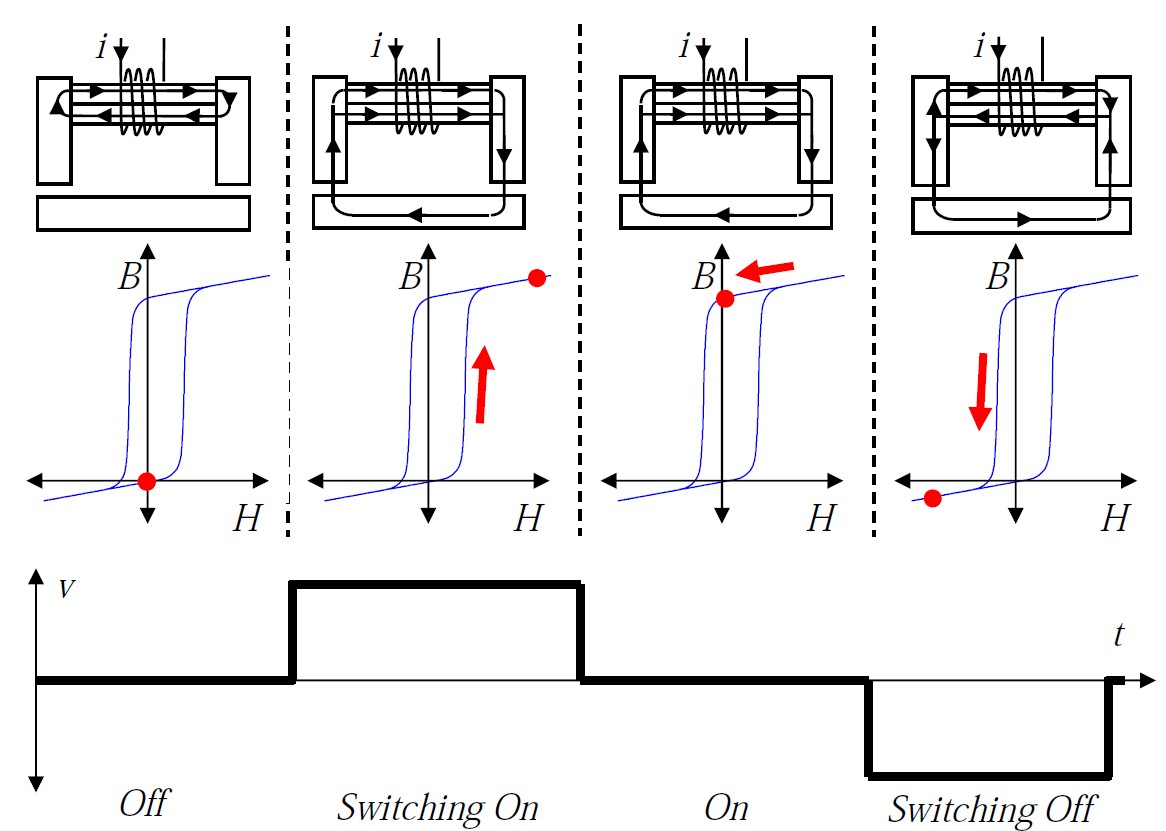
For those with a bit of physics background, these B-H curves tell the story
But recently I saw an article about "kleefklimmen" (http://www.schuttevaer.nl/nieuws/actueel/nid12488-europort-kleefklimmen-op-europort-2009.html) a technique which uses electropermanent magnets to climb on any steel structure (or any magnetisable material) The main advantages of this system are no power consumption while the magnet is on, which is much saver in the application of climbing. But this technique of electro permanent magnets can also be used to lock the sail actuator and rudder in position which cause them to use absolutely no power while they are locked in this position. Because the sailing drone will sail large distances in the same direction the and sail settings don't need to be adjusted continuously which can save a lot of energy.
The sailing drones will be autonomous and thus harvest their own energy with solar cells or in any other way. But the fact is there is a limited amount of energy available for the sailing vessel at open sea. Therefore this system can save a lot of energy, compared with normal servo's which require constant power.
For now I will make an appointment with Henk Huisman an expert on electro permanent magnets which I came in contact with through Bas Gravendeel the inventor of "kleefklimmen". in the next post I hope to give more information about the strength and power consumption of the system as a total.
For those with a bit of physics background, these B-H curves tell the story
presentations next nature
During this Semester we present our work 2 times. Last Friday was the second time we presented our work so far for the next nature theme.
For this presentation I wanted to show what I've achieved in the past semester and my final steps to end this semester.
In the video below you can see my presentation.
For this presentation I wanted to show what I've achieved in the past semester and my final steps to end this semester.
In the video below you can see my presentation.
donderdag 3 mei 2012
Wind sensor
To build an autonomous sailing vessel, a wind direction sensor is necessarily for the boat to function. Unfortunately there are no off the shell wind direction sensors which are cheap. On the internet there are amazing prices starting from $150 till thousands of dollars.
The target for me was to build a wind direction sensor for less than $15 dollars (10% of the lowest internet price).
Finding the good electronics took some time, potmeters aren't able to rotate continously so the best solution was to use a rotary encoder. There are 2 types of absolute rotary encoders; optical and mechanical.
In this case to optical rotary encoder is used works with gray code and works in the following way:
the optical encoder's disc is made of glass or plastic with transparent and opaque areas. A light source and photo detector array reads the optical pattern that results from the disc's position at any one time.
This code can be read by a controlling device, such as a microprocessor or microcontroller to determine the angle of the shaft. (source: wikipedia.org)
The total costs of all the materials are:
COM-09117 rotary encoder from sparkfun €2.24
2 perspex tubes diameter 21*16 and 15*11 €2,00
The target for me was to build a wind direction sensor for less than $15 dollars (10% of the lowest internet price).
Finding the good electronics took some time, potmeters aren't able to rotate continously so the best solution was to use a rotary encoder. There are 2 types of absolute rotary encoders; optical and mechanical.
In this case to optical rotary encoder is used works with gray code and works in the following way:
the optical encoder's disc is made of glass or plastic with transparent and opaque areas. A light source and photo detector array reads the optical pattern that results from the disc's position at any one time.
This code can be read by a controlling device, such as a microprocessor or microcontroller to determine the angle of the shaft. (source: wikipedia.org)
the other materials I choose to work with are perspex because in this way it is easy to see how the wind direction sensor is build, but essentially can be made out of every material at hand.
The most important part is to protect the rotary encoder from the force of the wind and only let the rotational force work on the rotary encoder. Therefore I build a shaft around the rotary encoder which will prevent the wind banner to bent the electronic parts.The total costs of all the materials are:
COM-09117 rotary encoder from sparkfun €2.24
2 perspex tubes diameter 21*16 and 15*11 €2,00
Vivak sheet 300*300 mm*1 €1.69
___________________________________________________
total €5.93
presentation next nature last week
a few seconds are missing between part 1 and 2.
personally i'm not completely happy with my presentation.
and especially afterwards I wanted that I could elaborate more on the concept
cross coach meetings
During this semester next nature changed the way we get feedback during a semester.
Twice during the semester we present our work in a 3 minute presentation per person and three times during the semester we would have cross coach meetings were other coaches would give feedback on the work of all students.
Unfortunately the presentation session didn't worked for me to get feedback. Even though I had 3 specific questions/ areas I wanted feedback on, the audience didn't respond to my request. This feeling was shared among other students and also the cross coach meetings were not succesful because only my own coach showed up during the first and second meeting. So even then I couldn't get feedback from another perspective.
After a meeting with Koert van Mensvoort (team champ of next nature) we decided it was to early to draw conclusions based on a half semester, but I was free to arrange anything I liked. So at the start of the semester I just talked with several other coaches as well as students to get feedback on my process.
I organised my own cross-coach session with 2 coaches and the protei/wild robots group. During this meeting I was able to receive quality feedback and below you can find (a long!) video of 2/3 of the meeting (last movie file is corrupted).
movie on update when youtube is ready
Twice during the semester we present our work in a 3 minute presentation per person and three times during the semester we would have cross coach meetings were other coaches would give feedback on the work of all students.
Unfortunately the presentation session didn't worked for me to get feedback. Even though I had 3 specific questions/ areas I wanted feedback on, the audience didn't respond to my request. This feeling was shared among other students and also the cross coach meetings were not succesful because only my own coach showed up during the first and second meeting. So even then I couldn't get feedback from another perspective.
After a meeting with Koert van Mensvoort (team champ of next nature) we decided it was to early to draw conclusions based on a half semester, but I was free to arrange anything I liked. So at the start of the semester I just talked with several other coaches as well as students to get feedback on my process.
I organised my own cross-coach session with 2 coaches and the protei/wild robots group. During this meeting I was able to receive quality feedback and below you can find (a long!) video of 2/3 of the meeting (last movie file is corrupted).
movie on update when youtube is ready
woensdag 2 mei 2012
User interface
After the expert meetings it became clear which parameters should be used to control the boat.
The parameters which need to be definitly given by the user are the heading or location the boat has to go to.
Further more I would like to have more options for the user, in the end, the user has build his boat and put a lot of time in it, therefore I want to give the user the option to control more parameters of the boat.
This is the reason I conducted a small user test with 9 users.
The prototype consisted of several layers which can be turned individually, the layers are:
- the boat
- compass
- sail
- wind direction
The goal of the user test was to find out how people want to navigate their boat and how they can adjust the sail.
In the user test the wind direction was given and also a desired heading was given to the user.
8 out of 9 users preferred to turn the boat to the right heading and one of the users turned the compass to make the front of the boat heading into the right direction.
adjusting the sail was found really easy for all users. However the user test was conducted with a physical prototype and without text explaining the functions. In the end design the user interface will be digital, so I cannot draw conclusions out of this test regarding the final design but this helped designing the next digital design.
The parameters which need to be definitly given by the user are the heading or location the boat has to go to.
Further more I would like to have more options for the user, in the end, the user has build his boat and put a lot of time in it, therefore I want to give the user the option to control more parameters of the boat.
This is the reason I conducted a small user test with 9 users.
The prototype consisted of several layers which can be turned individually, the layers are:
- the boat
- compass
- sail
- wind direction
The goal of the user test was to find out how people want to navigate their boat and how they can adjust the sail.
In the user test the wind direction was given and also a desired heading was given to the user.
8 out of 9 users preferred to turn the boat to the right heading and one of the users turned the compass to make the front of the boat heading into the right direction.
adjusting the sail was found really easy for all users. However the user test was conducted with a physical prototype and without text explaining the functions. In the end design the user interface will be digital, so I cannot draw conclusions out of this test regarding the final design but this helped designing the next digital design.
donderdag 26 april 2012
vrijdag 20 april 2012
ted X summit
We were reffered to in this Ted X movie of 3 hours about protei.
at 1 hour 33 minutes the live stream is about protei and are we mentioned as part of the community!
to watch the live stream see below:
at 1 hour 33 minutes the live stream is about protei and are we mentioned as part of the community!
to watch the live stream see below:
Watch live streaming video from tedxsummit at livestream.com
or the link:
http://www.livestream.com/tedxsummit/video?clipId=pla_32a87b40-fb12-4278-8eb7-6eedf15124fd&utm_source=lslibrary&utm_medium=ui-thumb
or the link:
http://www.livestream.com/tedxsummit/video?clipId=pla_32a87b40-fb12-4278-8eb7-6eedf15124fd&utm_source=lslibrary&utm_medium=ui-thumb
zondag 15 april 2012
Go-Tan developments(dutch)
The ideas we developed for the company Guerrilaz are listed below at this moment we are still waiting for the feedback of the company, although we already explained the concrete plans to build and produce some of these ideas.
Goodies:
• Indonesische hoed. Gebaseerd op de traditionele hoofddeksels die ze in Indonesië gebruiken. De link naar
de oorkomst van het merk komt hierin erg goed naar voren.
• Sjaal (2 gaten erin; kan aan elkaar geritst worden). Hierin komt de het groepsgevoel naar boven. De sjaal
kun je op twee verschillende manieren gebruiken, met vrienden om onder te zitten en warm te blijven of
om op te zitten tijdens de het festival zelf.
• (Chili- powered) beer cooler. Een add-on voor om de plastic bekers van festivals, die het bier langer koel
houdt dan normaal. Er kan eventueel gekeken worden naar een chemische reactie met chili die dit waar
zou kunnen maken. De link hier ligt bij het (langer) genieten van eten en drinken met go-tan.
• Peperhoedje. De bovenkant van een peper kan als hoedje fungeren; tegen de zon en de link naar chili door
de vorm.
Foto-acties (foto’s worden thuis gestuurd na opgeven adres via site):
• Mensen vanuit Go-Tan die rondlopen over het festival die foto’s maken
Door e-mail adressen te verzamelen bij de foto’s kan de begunstigde via zijn mail een invulformulier
ontvangen om de festival foto thuis te laten sturen. Dit wordt via mail gedaan om de eerste handeling zo
gemakkelijk mogelijk te houden(alleen een e-mail adres afgeven). De foto wordt thuis gestuurd in een
fotokader van Go-tan inclusief een kortingsbon en receptidee om met Go-tan producten te koken voor
een studentenhuis. Op deze manier is er ook een directe koppeling naar van communicatie naar de klant
toe, direct naar activatie om ook producten te kopen.
• Stand als bord, met opblaasbare attributen. Hoe gekker hoe beter (combinatie chili).
Door de foto’s met attributen erbij te nemen worden de festivalgangers meer uitgedaagd om gekkere
foto’s te nemen (die leuker zijn om te bewaren waardoor ze langer op de koelkast deur hangen). Ook
heeft hoe gekker hoe beter een link met chilisaus, het is de bedoeling om de Nederlanders chilisaus te laten
zien als een saus die je overal bij kunt gebruiken, pasta, tosti, aardappels etc. of terwijl hoe gekker hoe
beter!
• Chilimeter (ben je sweet of ben je hot)
Bij de chilimeter wordt ook een foto gemaakt maar hierbij wordt gemeten hoe gek je doet door de
chilimeter achterop de foto, ook hier geldt hoe gekker hoe beter! Hierdoor wordt ook hier het publiek
gestimuleerd om zo gek mogelijk te doen waardoor de foto’s leuker worden en er een grotere stimulus is
om de foto te gaan maken bij de stand en te bewaren.
Go-tan als merk geheel te promoten
• Kroepoek zitzakken
Fatboy’s met opdruk van de kroepoek zakken, het loungen op de zitzakken met Go-tan hapjes.
Stimuleert het samen zijn en samen genieten waar het merk voor staat.
Goodies:
• Indonesische hoed. Gebaseerd op de traditionele hoofddeksels die ze in Indonesië gebruiken. De link naar
de oorkomst van het merk komt hierin erg goed naar voren.
• Sjaal (2 gaten erin; kan aan elkaar geritst worden). Hierin komt de het groepsgevoel naar boven. De sjaal
kun je op twee verschillende manieren gebruiken, met vrienden om onder te zitten en warm te blijven of
om op te zitten tijdens de het festival zelf.
• (Chili- powered) beer cooler. Een add-on voor om de plastic bekers van festivals, die het bier langer koel
houdt dan normaal. Er kan eventueel gekeken worden naar een chemische reactie met chili die dit waar
zou kunnen maken. De link hier ligt bij het (langer) genieten van eten en drinken met go-tan.
• Peperhoedje. De bovenkant van een peper kan als hoedje fungeren; tegen de zon en de link naar chili door
de vorm.
Foto-acties (foto’s worden thuis gestuurd na opgeven adres via site):
• Mensen vanuit Go-Tan die rondlopen over het festival die foto’s maken
Door e-mail adressen te verzamelen bij de foto’s kan de begunstigde via zijn mail een invulformulier
ontvangen om de festival foto thuis te laten sturen. Dit wordt via mail gedaan om de eerste handeling zo
gemakkelijk mogelijk te houden(alleen een e-mail adres afgeven). De foto wordt thuis gestuurd in een
fotokader van Go-tan inclusief een kortingsbon en receptidee om met Go-tan producten te koken voor
een studentenhuis. Op deze manier is er ook een directe koppeling naar van communicatie naar de klant
toe, direct naar activatie om ook producten te kopen.
• Stand als bord, met opblaasbare attributen. Hoe gekker hoe beter (combinatie chili).
Door de foto’s met attributen erbij te nemen worden de festivalgangers meer uitgedaagd om gekkere
foto’s te nemen (die leuker zijn om te bewaren waardoor ze langer op de koelkast deur hangen). Ook
heeft hoe gekker hoe beter een link met chilisaus, het is de bedoeling om de Nederlanders chilisaus te laten
zien als een saus die je overal bij kunt gebruiken, pasta, tosti, aardappels etc. of terwijl hoe gekker hoe
beter!
• Chilimeter (ben je sweet of ben je hot)
Bij de chilimeter wordt ook een foto gemaakt maar hierbij wordt gemeten hoe gek je doet door de
chilimeter achterop de foto, ook hier geldt hoe gekker hoe beter! Hierdoor wordt ook hier het publiek
gestimuleerd om zo gek mogelijk te doen waardoor de foto’s leuker worden en er een grotere stimulus is
om de foto te gaan maken bij de stand en te bewaren.
Go-tan als merk geheel te promoten
• Kroepoek zitzakken
Fatboy’s met opdruk van de kroepoek zakken, het loungen op de zitzakken met Go-tan hapjes.
Stimuleert het samen zijn en samen genieten waar het merk voor staat.
donderdag 12 april 2012
expert meetings
The weeks before easter I scheduled two expert meetings.
The first one was with Emilia Barakova, Ph.D. Faculty of Industrial Design and expert on intelligence in products and human interaction measuring http://www.idemployee.id.tue.nl/e.i.barakova/
I started this meeting with the idea that learning algorithms would be a good solution to make my sailing vessel autonomous. In the discussion with Emilia I found out that learning algorithms aren't always the best solution for a problem. After the meeting I worked with some models based on Q-learning. I found out that the software keeps making the same mistakes over and over again, which is a problem with a real sailing vessel. Also the task the boats needs to perform with the given sensor data is already known if the wind is coming from the north and your heading is also north, the boat needs to tack upwind. This way of programming the autonomous behavior is also much easier.
The second meeting was with René Ahn.
He also works on the faculty of Industrial design in the Design Intelligence group.
In this meeting the focus was on the user. Which information does the user needs to control the boat, and which information does the user needs to give to the sailing vessel to keep it operational.
Another big issue I stumbled upon was communication. How to communicate with your own vessel when it is on the other side of the world in the middle of the ocean. Answers on this topic will come soon hopefully.
The first one was with Emilia Barakova, Ph.D. Faculty of Industrial Design and expert on intelligence in products and human interaction measuring http://www.idemployee.id.tue.nl/e.i.barakova/
I started this meeting with the idea that learning algorithms would be a good solution to make my sailing vessel autonomous. In the discussion with Emilia I found out that learning algorithms aren't always the best solution for a problem. After the meeting I worked with some models based on Q-learning. I found out that the software keeps making the same mistakes over and over again, which is a problem with a real sailing vessel. Also the task the boats needs to perform with the given sensor data is already known if the wind is coming from the north and your heading is also north, the boat needs to tack upwind. This way of programming the autonomous behavior is also much easier.
The second meeting was with René Ahn.
He also works on the faculty of Industrial design in the Design Intelligence group.
In this meeting the focus was on the user. Which information does the user needs to control the boat, and which information does the user needs to give to the sailing vessel to keep it operational.
Another big issue I stumbled upon was communication. How to communicate with your own vessel when it is on the other side of the world in the middle of the ocean. Answers on this topic will come soon hopefully.
meeting Imtech marine
Tuesday, I had a meeting at Imtech Marine in the harbour of Rotterdam.
Mart Hurkmans is the coordinator for research and development at imtech marine and developed a vision for his company to build unmanned autonomous ships (without emission, so green)we discussed some techniques to improve my boat, for example at the start when I build my boat I already wasn't happy about using servo motors. But at imtech they knew a technique which only uses energy when the position of rudder or sail needs to be changed and after this doesn't consume energy any more.
Also robosail and the university of technology in delft (faculty: maritieme technologie) can help a lot with implementing the autonomous sailing behavior.
also we stumbled upon a case scenario which doesn't has a solution yet.
what if something breaks on board for example a sensor dies? I hope to find a solution for this in the upcoming weeks.
At this moment I'm only working on decentralized systems which communicate with each other but also a zeppelin above all sailing vessels could help to get an overview on the sea. If this is a valuable insight? I will find out in the next weeks as well.
The main goal for imtech is to establish continuity in the projects all over the Netherlands. So that the knowledge we build up doesn't get lost when I stop working on this. To establish this I connected Mart Hurkmans with my coach on the TUE so maybe next semester this project can be continued with Imtech as a client and in this way make Imtech as a knowledge library for all other projects in the future.
woensdag 11 april 2012
maiden voyage
This was still a remote controlled version, but at this moment I can completely control the boat with a remote control but also with my laptop up till 1 km distance. At this moment I'm waiting for a delivery from Farnell with a gps module and a rotary encoder, this to make the first step to autonomous sailing behavior.
the rotary encoder is a cheap piece of hardware which I want to use to build my own wind direction sensor.
Updates on this of course when the parts are arrived here in the Netherlands.
In the mean time I will work on the interaction between the boat and the user. What are the parameters we can define and how can you visualize and interact with this without really seeing the boat?
donderdag 29 maart 2012
First test sailing Boat
First test in the water today!
Unfortunately I broke the rudder by pulling it to hard, so I won't do this abusive behavior anymore in the future, but i am also reinforcing the rudder at this moment.
For now:
Unfortunately I broke the rudder by pulling it to hard, so I won't do this abusive behavior anymore in the future, but i am also reinforcing the rudder at this moment.
For now:
next update monday evening. hopefully with a fully remoted controlled boat on a larger lake!
maandag 26 maart 2012
Remote controlled sailing vessel!
At this moment the sailing vessel can be remotely controlled, today I did a quick test, but more keel ballast needs to be added so that's my task for this afternoon. For this moment I can already show the mechanics of the boat. See video below.
zondag 25 maart 2012
Imtech marine + skype meetings
During the weekly skype meetings with our client and the meetings with the community on monday some interesting things come up. This blogpost will summarize the most interesting things of the past few weeks in these meetings.
DEAF 2012
during the meetings at the start of the project the agreement was made to present our results at the Dutch Electronic Arts Festival 2012 (short DEAF), this event on the 17th of May will be a podium to show our development for the protei community and also let us discuss our results with a lot of different people from within different fields of interest to widen our view on the project.
No flexible hull for protei TUE
During the meetings we decided to not use the flexible hull mechanism in the protei project at the TU/e this decision was made to save time with building the ships and start thinking about intelligence and user involvement as soon as possible
Imtech
Imtech marine has first hand experience with building autonomous sailing boats. They were interested in the work we do at the TU/e and contacted Piem Wirtz who brought Mart Hurkmans in contact with me.
DEAF 2012
during the meetings at the start of the project the agreement was made to present our results at the Dutch Electronic Arts Festival 2012 (short DEAF), this event on the 17th of May will be a podium to show our development for the protei community and also let us discuss our results with a lot of different people from within different fields of interest to widen our view on the project.
No flexible hull for protei TUE
During the meetings we decided to not use the flexible hull mechanism in the protei project at the TU/e this decision was made to save time with building the ships and start thinking about intelligence and user involvement as soon as possible
logo of TUE protei team.
Imtech
Imtech marine has first hand experience with building autonomous sailing boats. They were interested in the work we do at the TU/e and contacted Piem Wirtz who brought Mart Hurkmans in contact with me.
I made an appointment with Mart Hurkmans for the 10th of April to meet at Imtech Marine in Rotterdam.
In this appointment we can discuss the possibilities of working together on some parts and how we can use each others knowledge in the design process.
Also I asked other fellow student if they wanted to join me to visit Imtech marine and probably 4 students will join me.
In this appointment we can discuss the possibilities of working together on some parts and how we can use each others knowledge in the design process.
Also I asked other fellow student if they wanted to join me to visit Imtech marine and probably 4 students will join me.
Protei project concept ideas
Concept
The strength of the
Protei project is the community behind it. To extend this community I want to
design a autonomous sailing vessel which is easy to build yourself or cheap to
manufacture. Building different sailing vessels can create a large community of
people working on the same problem but when the boats are finished I don’t want
to lose this community, so the concept is based on the user interaction
starting from when the boat is finished to the very end of its life.
Because autonomous
sailing isn’t so easy yet (http://www.ssa.ethz.ch,
http://www.sciencedaily.com/releases/2009/01/090119113903.htm)
I will not aim to make this boat completely autonomous. This makes it also
possible for the community to stay connected to their own boat after it hits
the oceans. By adjusting the parameters of the boat (parameters which influence
how fast the boat makes the decision to make a turn for example) and routing
the boat to places with a large oil spill, it is possible to influence the boat
even in the middle of the ocean.
This opens the way for serious gaming. Real sailing
vessels remotely controlled by the community who build it. For now I want to
investigate what kind of rewards can be given (cleaning up oil is valuable for
governments and companies like BP) and
if the rewards should return to the protei project or can be withdrawn.
building a 1m sailing vessel
During the past 2 weeks I build a sailing vessel of PVC. at this moment the sailing vessel is almost finished. All parts are build and the actuators are placed, but at this moment the boat needs to be remote controlled which isn't implemented yet.
Below i show the building process of the sailing vessel:
I started building with a PVC pipe of 125 mm and heated this with a hot gun to shape it in the shape of a sailing vessel
Instant succes not guaranteed
After some time you will get this shape by cutting of half you will get a better shape
Me cutting of half of the pvc
Not instant good result as well a little adjustment to make it better.
After heating the PVC again it comes close together but pvc is made based on a chemical reaction so the parts will never glue together by heating. Therefore use PVC glue to glue the parts together.
Close up of the glued parts
Time to make the sails:
the sails are made of old sails from a optimist (small sailboat for children).
this sail is cut in to the right shape.
The shape which I chose is Gaff rig (see wikipedia: http://en.wikipedia.org/wiki/Gaff_rig)
with zeil ogen (dutch word and untranslatable by google translate.. but those are the metal rings in the sail)
you can attach the sail to the mast. The mast is made from aluminium pipes see pictures. The measurements of the sail will follow later on.
Height mast:
width:
angle gaff rig:
length gaff rig:
attached gaff rig to the mast.
time to attach the keel as well. to attach it as good as possible I decided to put them inside the hull of the boat and attach them to pieces of plywood which are glued to the hull itself. This resulted in a very strong and rigid connection.
after attaching the keel everything is sealed with silicone to make the connection also water tight.
after the connection of the keel, the rudder could be connected as well. In this case the servo is mounted upside down in the hull and a wooden stick is attached to the turning mechanism of the servo. the wooden stick is connected to the rudder (see below: left keel, right the rudder) and connected to the keel to share the weight of the rudder and to keep it more stable.
after closing the back side of the sailing vessel you have a water tight boat.
good luck with building one yourself!
more pictures and explanation will follow soon.
Abonneren op:
Posts (Atom)